I was today years old to realise that the music for the Commodore 64 game “Lazy Jones” music is the sample used by Zombie Nation’s “Kernkraft 400“.
Kernkraft 400 became Wales’ anthem after a match away at Belgium in the mid-2010s when the DJ played it at half time. I think the favourable conditions for Wales and the 48 hours of Leffe Blonde meant it was swiftly added to Y Wal Goch’s playlist, so much so that it was played in bars as I travelled around France in Euro 2016, usually the ones filled with the Welsh. We were no trouble, like.
You would have thought I’d have become aware of it, given my love of retro games. But no, I was told today. Thanks Matt!
As annoyingly it’s been a few weeks since I attended, so I’m going to leave the images doing the talking, but if you’re ever in the area and you like nerdy stuff like I do it’s well worth paying a visit. The items in the cave and connected Arcade Archive are beautifully maintained – I am struggling to think of a Street Fighter II machine that was so looked after and presented, it worked perfectly.
Whilst I could wax lyrical about the day and the event (it was good seeing folks again also), I would rather pictures tell the story. I will say my favourite little gimmick was the WH Smith esque area where you could scan the games to play them on a Mister. That was effortlessly cool.
Another one from the list!
The excellent looking WH Smith esque storeThe fabulous NEO GEO Pocket. My brother had one of these, no idea where it went. The joystick is wonderfully clickyA lovely tribute to one of my favourite games ever, DoomAn absolute pristine Unreal Tournament box. Literally immaculateGreat Giana Sisters. Super rare as it’s a bugger to get hold of. It’s a C64 take on Super Mario Brothers and Nintendo got Litigious.Beautiful pins. I want the Lemmings ones. Already looked on eBay. No chanceA complete collection of Codemasters games. I’ve a fair few of these (28 in my collection). Notice the Championship Wrestling game with “Hulk Hogan” on the frontThe Nintendo Kiosk. Is a multisystem that was used to advertise the NES in Japan (I believe). The 3 monitors synced up so I was playing “1 bullet, 1 screen” on Duck HuntI wanted this so much as a child. The Cartoon Classics Commodore Amiga…I had this when I was a child. Shudder to think how long I played it for.At least one person out there paid for WinZip!The Tower of Power. I did add a Game Genie to it too…didn’t work.The Acorn Archimedes was a great machine, used to pray for rain so we would boot these up and play Chuck Rock, Manchester United Europe or Lemmings on them.Serious softwareSo the machine on the left is a joint IBM PC and Megadrive. The machine on the right I think is a machine that was in cars. Not sure of the legality of that but there you go.
If you ever get the chance to go, you should. The Cave is brilliant and would love to go back again one day!
I saw an interview with one of the developers of ZSNES – one of the first truly great emulators. One of the key points, highlighted by PC Gamer and Time Extension was this great quote – how a developer achieved rollback netcode in 1997.
“30 times a second, I do a secret save state. The emulator plays ahead, maybe 30 milliseconds, and whenever it gets a packet saying the controller has changed, it rewinds to that frame and replays the emulation until the current point with that new input buffer.”
Rollback netcode, even nearly 30 years later, is still a sticking point for many online games. It’s fine for first person shooters where you don’t need millisecond accuracy, but for things like fighting games like Street Fighter, it’s crucial. Really the only first enjoyable experience on fighting games online for me was Super Street Fighter II Turbo: HD Remix which was released in 2008, and even now the first thing many fighting game enthusiasts talk about was how it’s like to play online.
The fact that the problem was solved in 1997 before it is even a thing is so joyful.
I did manage to play ZSNES online in Business Studies class back in the day. Usually we were playing Bomberman or Mario Kart. Never got it working over dialup, but for a free version over a decent network, it is probably better than a lot of rollback netcode today.
One of the highlights of my year is Play Expo – a weekend away in Blackpool that has a bunch of retro and modern video games. It’s pretty much the same every year: arcade machines as you walk in, trading hall to the left, pinball machines to the right, home consoles towards the back along with the main stage. Play Expo has a familiarity to it, which makes it a must attend every year for me. If only to see the same faces every year.
The traders hall is often a place I go for a wander. Not straight away, as it’s hectic, but towards the middle afternoon on Saturday it dies down a bit and you get to check out the trading hall, have a bit of a chat and just generally have a better buying experience. You feel less pressured as you check through the boxes on the floor (which – as somebody who has dropped 3 stone in the past year – is a lot more easier experience on the knees).
One such place is The Gaming Newsagent – a long time attendee that started as SegaMags, but branched out into all such other magazines. It was in one of these boxes and a bit of time for exploring I found this magazine. St Format issue 70, from May 1995. An immediate buy. When I said immediate, I meant immediate. I never bothered looking through the rest.
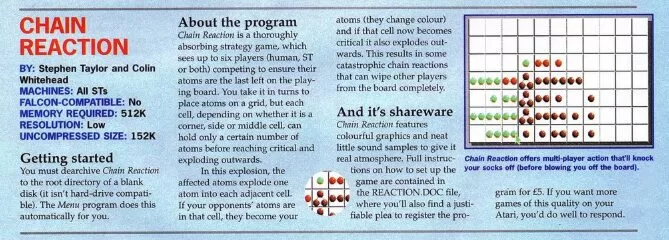
So what was so special? This small PD Game on the cover disk, Chain Reaction. A simple addictive game I played so much and stuck with me for a while. Here whas what was written about it.
Chain Reaction from ST Format Issue 70 (image taken from Atari Mania)
If you followed me online for a while, you’d know that this sounds a lot like a game I made. Gone Fission! was inspired by Chain Reaction (and a thousand other PD games, I’ve got an article in my drafts where I talk about all different versions of the game and everything cool that has happened post launch. This is another of those things to add to that post, in a fun coincidence.
Anyway, weird kind of full circle on a side project that dominated this year.
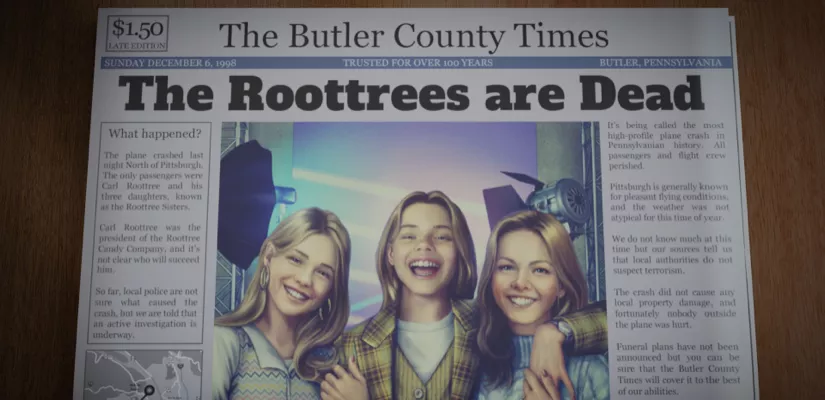
Last night I’ve just finished a game that will feature very highly in my “Game of the Year” blog post – The Roottrees Are Dead. It’s a wonderfully charming romp to map a family tree to see who stands to gain a large inheritance. It’s a classic detective game in the style of The Return of the Obra Dinn (my game of the decade) and, whilst it doesn’t quite stick the landing – it suffers the same fate as most of these games do in that once you get close to the end it becomes guessable – it’s well worth your time.
As with all of these games, once completed (there’s a nice little twist towards the end), I dived into the read more about the game. Whilst The Roottrees are Dead was released earlier this year, it is a “remaster” of a game released a few years back, and the previous version did use generative AI. Only when the original game was released completed and got a bit of traction did the original developer switch to use proper assets – which saw the game become a success.
Good AI in Gaming? Maybe?
It gave me a bit of an uneasy feeling when I read that, and I think I wanted to try and justify it. The game right now that is on Steam is guilt free – beautifully drawn images, great soundtracks, voice acting, it’s a wonderful game. The AI version? Well, it’s still in essence the same game (deciphering photography is a key part of the game), but I doubt I would have played it.
I then thought about would the game have seen the light of day with the AI version? Sadly, doubtful. But once the proof of concept was there, the author did the right thing by seeing it’s potential and investing in artists to see their vision cross the line. So I think I’m happy about it.
Rubbish AI in Content Creation
I awoke this morning to find a video on my feed from YouTuber icklenellierose, that helped crystalise my thoughts on Generative AI and why it’s bad. You should watch it all below. Grab a brew, it’s good.
The basic gist of some of the elements was the fact she was tricked (from an “Inspiration” tab) to get a few video ideas. Generative AI – particularly for artists and creators – can be a touchy subject. Some folks really don’t want to use it for their well optimised creation process, and I must say I can’t blame them. I was a relative late comer to AI within my code, and even then I use it sparingly, and I curse Copilot for auto”correcting” code I write at times. Just stop it.
I’m reminded of a quote from Homer Simpson where he talks about the obnoxious character – Poochie – being added to the Itchy and Scratchy Show:-
One, Poochie needs to be louder, angrier, and have access to a time machine. Two, whenever Poochie’s not on screen, all the other characters should be asking “Where’s Poochie”?
Homer Simpson – “The Itchy & Scracthy & Poochie Show”
I feel AI is being Poochiefied. There are some genuinely cool things out there, I use it in my job at times (I used it yesterday to come up with a small idea to extend a blog post as I was under a word count and was struggling). In fields such as medicine it could be genuinely useful.
I don’t think it’s the be-all and end all mind. Keeping up with developments is both tiring and nothing makes me want to switch off a podcast than saying “We’re going to talk about AI”. Nobody as of yet has come up with a cool reason why I should use it, beyond asking it for sorting arrays, working out where I’ve gone wrong with my code or finding a hook I can use within a plugin with code everywhere. As such, I’m not convinced yet it is the deserving of the amount of column inches it serves.
I especially don’t like it when AI is either front and centre (I had an “AI Summary” present itself in Slack yesterday without asking) or when people are tricked into using it with dark UX. I imagine situations like Ellen describes and experienced by us all during our days is used in board room presentations on how the adoption of AI has been a complete success and it’s what customers want. Using words like “uptake has been stellar”.
That then leads to situations like what was on before Google did put up their prices of business accounts that’s sold on “greater AI integration”.
Cheers for asking, dicks.
I think that’s the point I’m trying to make. I don’t necessarily mind AI if it is presented in such a way that it is an option to use, and there has been education on it and also it doesn’t lurch to “Yay Nazi’s are great!”.
However, I don’t want to work where my processes are having to change due to having AI forced on me.